DeepEarth

AI for Planetary Science & Sustainability

DeepEarth is a self-supervised, multi-modal, spatio-temporal world model for global environmental intelligence and optimization.
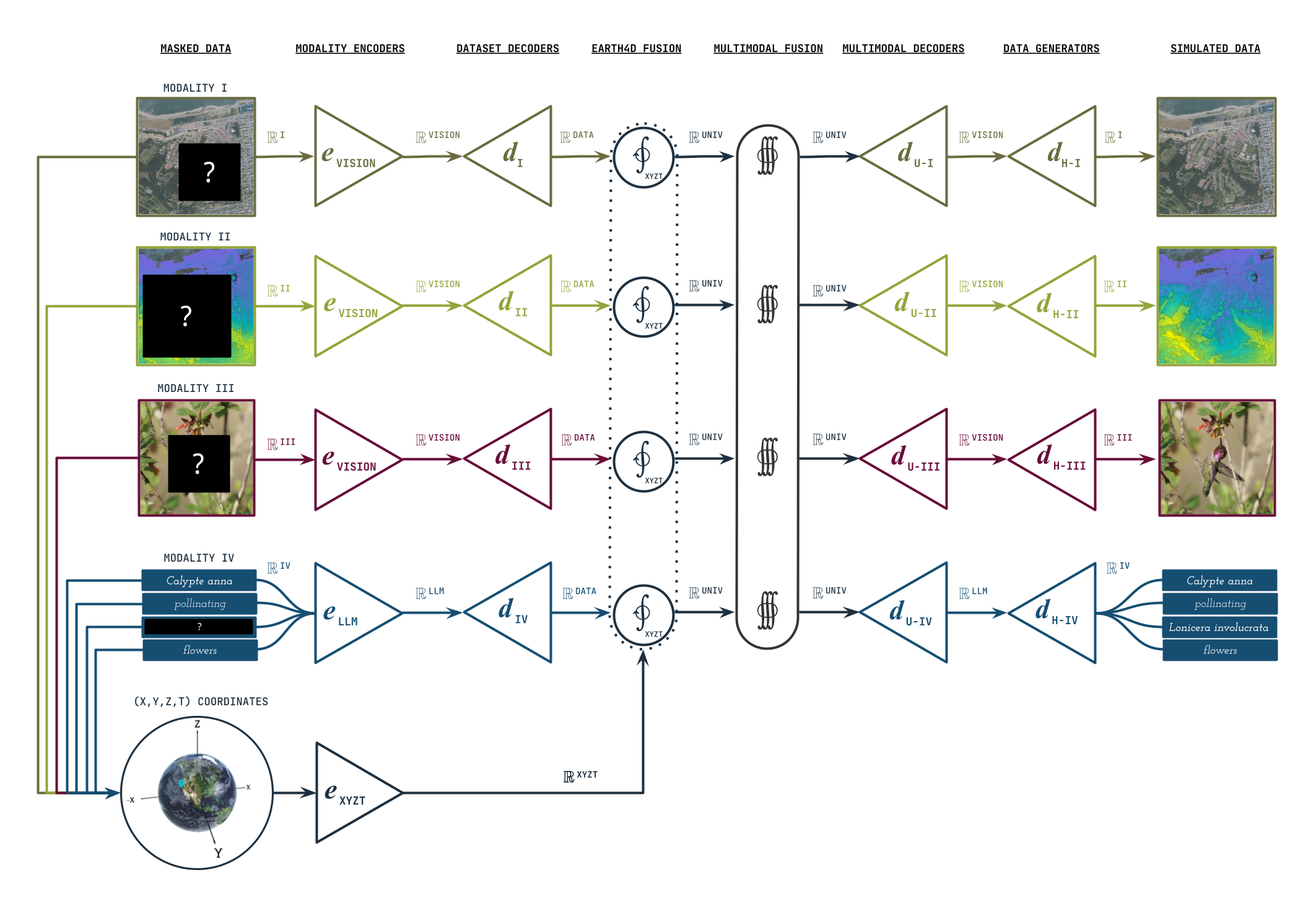
DeepEarth architecture
Figure 1. Self-supervised multi-modal world model for planetary science, simulation, and planning.

It learns by jointly reconstructing masked multi-modal datasets distributed across space and time, using a novel space-time positional encoder, Earth4D, built for earth observation data.

Key Contributions
  1. Space-Time Positional Encoder. Unify all kinds of physical data modalities.
  2. Multi-Scale 4D Geospatial Simulator. Bridge planetary-to-cellular dynamics.
  3. 4D Learned Hash Probing. Differentiably map (x, y, z, t) to embedding indices.
Usage
# https://github.com/legel/deepearth
from deepearth.encoders.xyzt.earth4d import Earth4D

world_model = Earth4D()

embeddings = world_model(
    # Bletchley Park (Turing breaks Enigma, 1941)
    (51.9976, -0.7416, 110, "1941-06-01 09:00 GMT"),
    # Carnegie Mellon (Hinton invents Boltzmann Machines, 1985)
    (40.4433, -79.9436, 270, "1985-01-15 10:00 ET"),
    # CERN (Berners-Lee invents WWW, 1989)
    (46.2330, 6.0557, 430, "1989-03-12 10:00 CET"),
    # Mila, Quebec (World Modeling Workshop 2026)
    (45.5308, -73.6128, 63, "2026-02-04 11:00 ET"),
)

# embeddings.shape: [4, 192] -- trainable space-time features